Designing AI for the Invisible Work of Families — Featured on Google Play within 2 Months
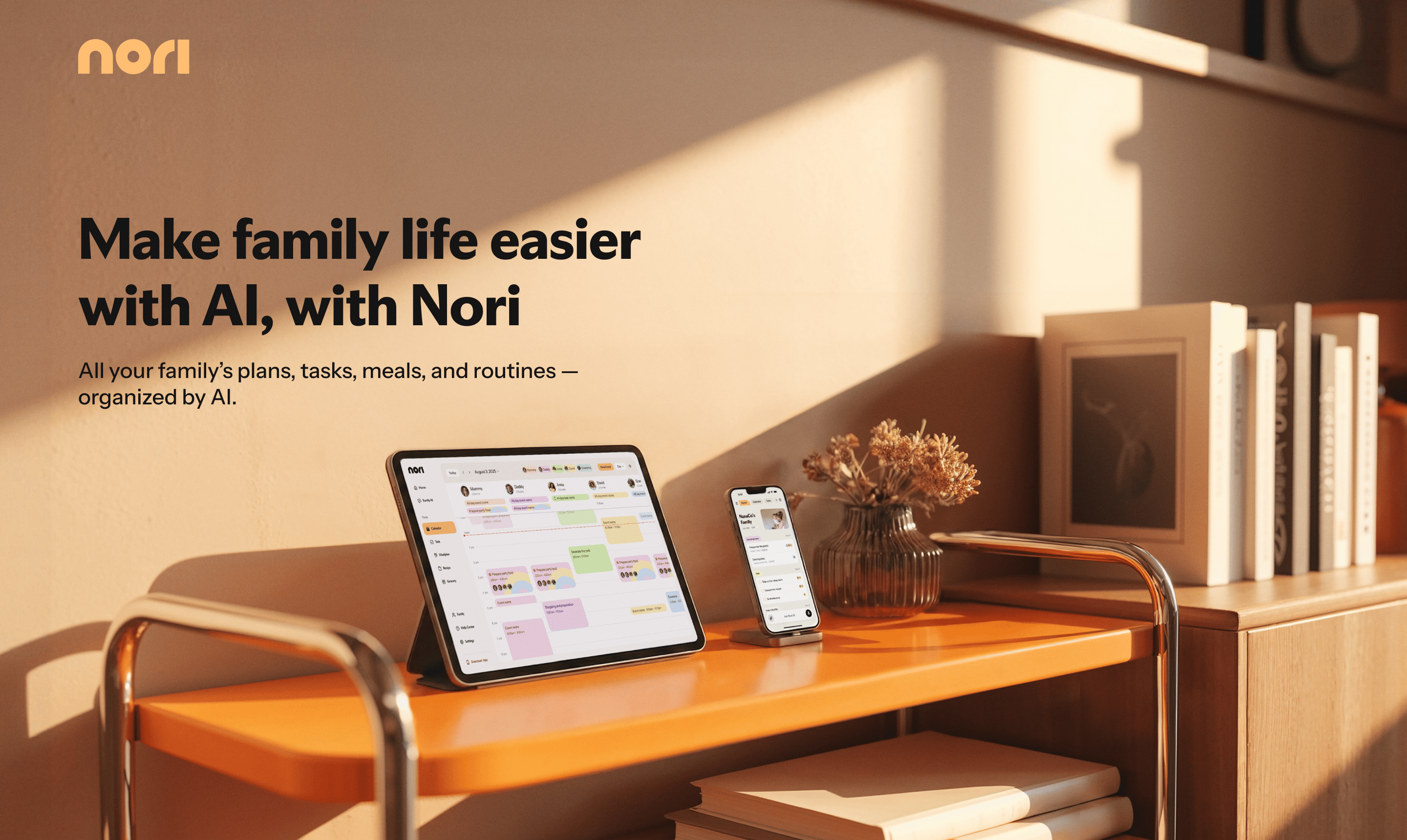
From household friction to family connection — we’re giving families back the time they deserve.
“It makes my mom not be mad.”
When we encountered this review on Google Play, it resonated deeply with our team. To us, it was more than just a kind word; it was the ultimate validation of Nori’s mission. It served as a powerful reminder that while AI is often measured by efficiency, its real value lies in protecting the small, everyday moments of family warmth from being consumed by logistics.
Featured by Google Play
In April 2026, just two months after our launch, Nori was featured in a Google Play Global editorial: “A career coach’s top 5 AI power-ups.”
In the selective landscape of Google Play’s Feature Stories, Nori was curated alongside established industry names such as Adobe, Gemini, and Otter.ai. For a young startup, being included in the same conversation as these pioneers is a meaningful nod to our design philosophy and our early efforts in redefining how AI serves the modern family.
Our Team
Nori’s design team comes from a range of backgrounds, but we share a common trait: a deep commitment to thoughtful design.
Design Lead Lanaya: Spearheaded the design of multiple collaborative tools. Previously, as the Design Owner for Doc Editor and AI at Zoom Docs, she established a cross-scenario AI interaction framework and patterns that were adopted as the unified direction for Zoom UED’s cross-scenario AI interaction guidelines. Expertise: Our team also includes designers who have worked on emotional design for AI-powered hardware, as well as contributors behind multiple large-scale apps with millions of users.
The Vision Behind Nori
"AI shouldn’t only be about efficiency and productivity. If it could help reduce the daily load at home — especially for moms — that would matter far more."
When people think about AI at home, they often think of voice assistants like Alexa, or smart home control. But within our team, many of us grew up watching our mothers — whether full-time caregivers or working professionals — take on the majority of household coordination: managing calendars, assigning chores, planning meals. This work is rarely visible, rarely measured — but always present. We believe AI should act more like a household operator: not just controlling devices, but helping coordinate information, relationships, and everyday decisions. Things like:
- planning meals
- organizing shopping
- booking restaurants
- coordinating family schedules
This is where Nori began.
What we learned from research
Nori is grounded in real-world family dynamics. Across extensive research and user interviews, one pattern became clear:
The problem isn’t a lack of tools — it’s the cost of using them.
Across thousands of families, we repeatedly observed:
- About 75% of household chores and tasks are primarily assigned by the mother, with verbal assignments being the mainstream method, while some use various apps or paper tools;
- On average, 30 minutes a day is spent switching between different family management apps and tools, causing friction, and 2–7 hours per week are used for coordinating schedules, chores, meals, and shopping;
- Information is scattered across multiple places such as different apps, paper notebooks, screenshots, whiteboards, etc.
- Family members struggle to collaborate effectively: the husband doesn’t use the app, the kids don’t have phones, and some people don’t check notifications. Issues with synchronization and cross-device compatibility, insufficient or missed reminders, and difficulties integrating tasks mean that family information is heavily concentrated on one person—the mother—who ends up acting as the “family dispatcher,” leading to significant stress.
As tools expand in features and scope, they also become more complex and harder to maintain. We found that users don’t abandon tools because they lack functionality, but because:
- coordination fails
- maintenance is too costly
- input takes too much effort
Even existing family organizer apps often feel outdated, time-consuming, and hard to adopt. At some point, we realized:
Solving this problem isn’t about building a better version of the same product. It requires changing who operates the system.
So our most straightforward idea is to let AI handle the tools, rather than requiring people to learn or adapt to complex operations. In the past, mothers had to spend a lot of time learning what each field meant and figuring out how to click through the GUI just to add calendar events or assign tasks. AI can precisely free them from this burden.
How We Designed Nori
A question that kept coming up internally was: How would this work for the busiest person in the household — especially someone who isn’t particularly interested in learning new tools? Applying AI to address these household challenges requires insight into real users' life situations and contexts, weaving Nori's assistance seamlessly into daily routines so the system adapts to people's natural ways of living.
Multimodal input that fits into daily life
The closer input feels to how people naturally express things, the more likely they are to use it. We make voice and text the primary entry points, enabling us to reduce experience creation — from what used to take dozens of minutes to just a few seconds — and conveniently set reminders for other team members while chatting with AI. Combined with image recognition, email forwarding, and other methods, this significantly lowers the barrier to information input.
- Voice Input: “Hey Nori, Anna has piano lessons every Thursday at 5 PM.” A single sentence creates a recurring event—making scheduling seamless, even from across a busy kitchen.
- Photo Recognition: Snap a picture of a new semester school flyer, and Nori automatically extracts the time and location to create a calendar event, quickly digitizing paper information to ease pre-semester busyness. Take a photo of a finished dish, and Nori helps generate a recipe with ingredients and preparation steps.
- Email & Link Forwarding: Forward recipe links and event poster files to Nori, which automatically generates shopping lists and schedules, seamlessly consolidating information from multiple scattered sources;
While AI can automate a lot, people still rely on the clarity and control that GUIs provide. While we offer smooth GUI interactions, we also provide users with an entry point for AI multimodal input during the creation process, helping them gradually become accustomed to using AI to complete tasks. So instead of replacing interfaces, we designed them to work together — with AI as a flexible input layer during creation, helping users ease into it over time.
Structured guidance for expressing intent
We also noticed that while natural language works well most of the time, it can become inefficient in more complex scenarios. Therefore, for a broader audience of non-technical users, conveying the desired information effectively becomes even more important. To address this, we designed an intuitive intent expression feature called the "Nori's Magic Touch" tailored for high-frequency use cases like Mealplan. Every weekend, when planning meals for the upcoming week, users can simply select a few preference tags and upload a photo of the ingredients in their fridge to Nori. This generates a weekly Mealplan with minimal back-and-forth communication while improving result quality in specific scenarios.
Aligning with real-life workflows
In real life, tasks are rarely isolated. Preparing a meal involves a sequence of steps—deciding what to eat, checking what ingredients you already have, updating your shopping list, and completing the purchase. Yet in traditional products, these steps are often scattered across different tools. In Nori, we connect each task into the natural flow of everyday life, enabling information to automatically and intelligently move between modules. The result isn't just a collection of tools—it's a true reflection of real-life routines. For example, when a user asks to "plan a week of gluten-free dinners," Nori doesn't just generate recipes and add them to the meal plan—it also lets users quickly add missing ingredients to a shared shopping list and even jump directly into Instacart for online ordering. By linking meal planning with shopping, Nori ensures you never buy ingredients only to realize you're missing key components.
Family Notebook
To make Nori the most understanding assistant for your home, we've designed a family memory feature. Simply tell Nori the information you'd like to remember using natural language, and it will help keep track of family members' dietary preferences, allergies, Wi-Fi passwords, doctor's addresses, and other details—then provide a specific interactive state to give you confirmation.
Keep in control
- Proactive Clarification: In the design of AI automation products, it is crucial to keep a "manual override" for users. In a family context, trust matters more than speed. When Nori lacks sufficient confirmation of an instruction, it proactively seeks clarification rather than executing directly, thereby enhancing automation reliability. For example, before adding ingredients to the shopping list after planning a meal plan, users are prompted to select and confirm.
- Call Alerts: Our research revealed that many users miss important matters (such as children's extracurricular activities or medical appointments) due to phones being on silent or failing to check notifications promptly. The core manager of household affairs bears the pressure of "remembering," while other family members may not actively check calendars or tools, leading to information gaps. Therefore, we designed a Call Alert notification method for schedules and tasks. Once users enable this setting for key events, all participating members will receive phone calls at the specified time, ensuring they don't miss anything due to silent mode or oversight. Additionally, schedule cards created in AI chat include a one-click toggle for Call Alerts, further streamlining the operation steps.
The Role of AI in the Home: More Than Just a "Tool"
We didn’t want Nori to feel like just another tool. Part of the inspiration came from Alfred, Batman’s butler, serves as a professional, reliable, and thoughtful companion who always prioritizes his master’s needs. This aligns closely with Nori’s vision of becoming a "warm companion" within the home. Nori’s cat persona embodies this philosophy—it is not merely an intelligent assistant for handling tasks, but also an "invisible butler" that carries the warmth of family life and provides emotional support. It is a family member full of companionship.
As a product designed for families, we don’t want Nori to convey too much instrumental rationality. Instead, we aim to provide users with inclusiveness and warmth, happiness and joy. Therefore, our design incorporates vibrant colors and illustrations full of everyday life vibes, making household chores feel more heartfelt.
Early Results
Since its official launch two months ago, Nori has received widespread acclaim across multiple platforms, with total app downloads exceeding 200k. It has achieved a rating of 4.8 on both iOS and Android and has been featured as an editor's pick on Google Play. Many users have commented that Nori has helped them solve long-standing problems, freed up their time, and is the first product that truly made a difference. Some even noted that Nori AI has changed their perspective on the practicality of AI. These responses affirm that Nori is on the right track.
What’s Next
Expanding into the physical world
Currently, Nori serves users solely as a pure software app on Web, iOS, and Android, still facing limitations such as "inability to wake up when the phone screen is off" and "lack of awareness of the rich real-world environment at home." To address these issues, we will launch the Nori Family Hub — a smart home hardware product, offering more immediate AI interaction and a more convenient large-screen operation method.
We expect that Nori AI will not only help manage household affairs (calendars, tasks, meal planning, children’s chores) in the future, but also assist in connecting with the physical world, such as purchasing groceries, and more. We will continue to approach every research and design process with a humble and earnest attitude, consistently conducting user interviews, gathering feedback, and analyzing data to iteratively refine and enhance Nori, making it more powerful and user-friendly.