Hermes Agent Explained 2026 | Self-Hosted Memory and Tool Control
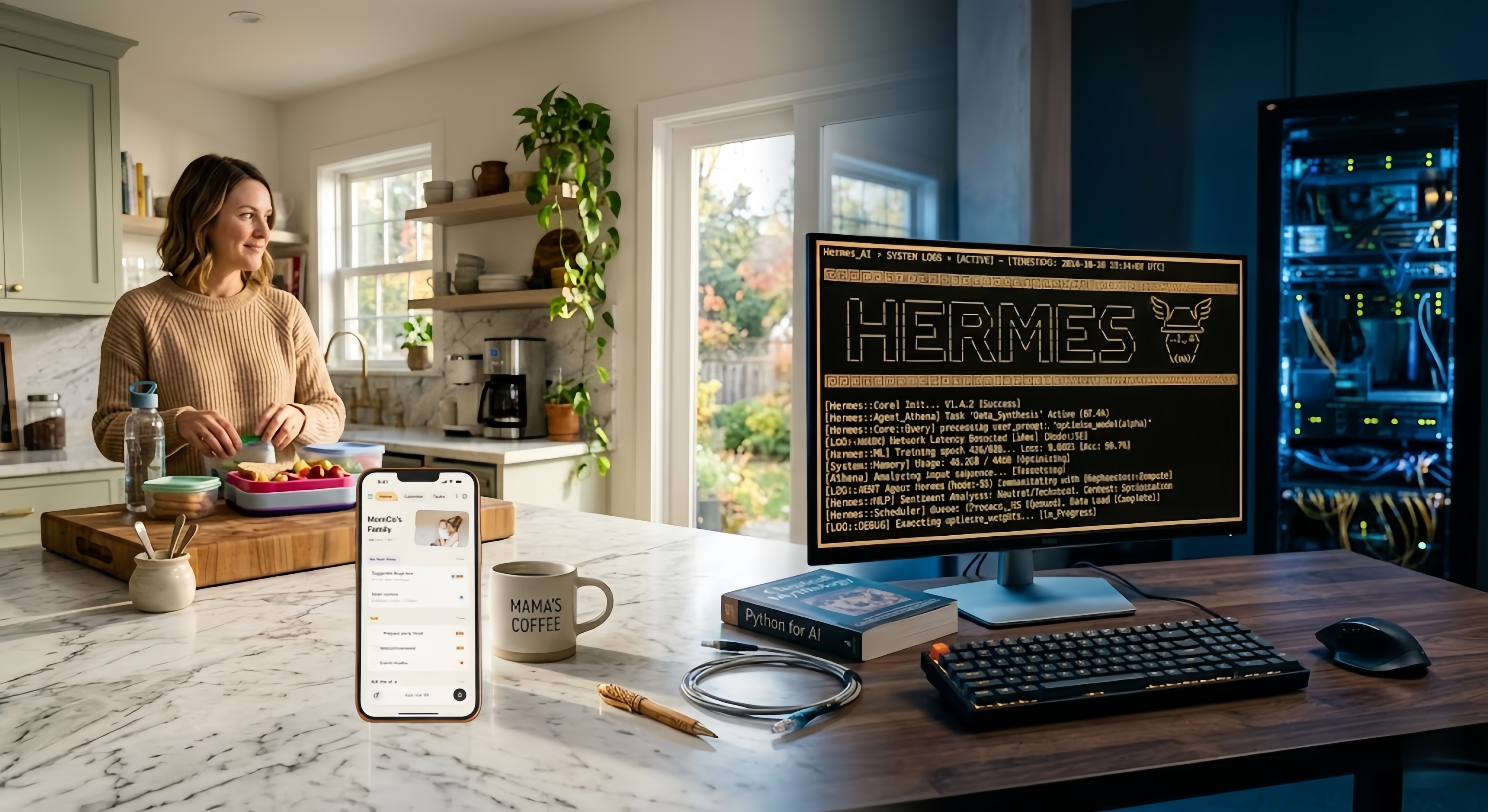
If you have read the tech press or scrolled developer feeds lately, you have probably seen Hermes Agent next to words like open source, self-hosted, and “the agent that grows with you.” The name is easy to confuse with unrelated brands, tokens, or mythological references—so this article starts with a narrow definition: Hermes Agent here means the open-source autonomous agent project from Nous Research, documented on hermes-agent.nousresearch.com and developed in public on GitHub (NousResearch/hermes-agent).
This piece is written as a guide, not a vendor teardown. We explain what Hermes is trying to solve, why that story resonates in 2026, and where household scheduling still benefits from a different kind of agent—one built for shared family calendars, voice and photo capture, and email-to-calendar workflows rather than SSH keys and model routing. If you already know you want ranked family apps, jump to best AI family organizer or best family calendar app. If you are calibrating how a digital calendar should work for a whole household, read family digital calendar first; it pairs well with the architecture thinking below.
At a glance: Hermes Agent is a general-purpose, self-improving agent platform you can host yourself—strong when you want control, extensibility, and long-running memory for personal or technical workflows. Nori is a family agent product: same broad idea—perceive, plan, act—but aimed at parents, caregivers, and kids’ schedules, with low-friction input (voice, photo, email) and a path that does not require you to operate infrastructure on weeknights.
What Is Hermes Agent?
Hermes Agent is an open-source AI agent you run on your own terms (local machine, server, or other backends, depending on how you configure it). The project pitches a simple promise that is technically hard: an assistant that does not reset to amnesia every session, that can reuse what it learned from past tasks, and that can connect to real tools—browsers, messaging surfaces, schedulers—rather than only chatting in a single web textarea.
In practice, reviewers and docs emphasize a few recurring themes:
- Persistence — conversations and outcomes can feed a searchable memory layer instead of living only in the current chat window.
- Skills or procedural artifacts — successful multi-step flows can be captured as reusable instructions (often discussed in the ecosystem as structured “skill” files), so the agent’s behavior can compound over time rather than starting from zero.
- Model flexibility — you can point the stack at different model providers instead of being locked to one API brand, which matters to people who already standardize on OpenRouter-style routing or self-hosted inference.
- Many surfaces — community interest often focuses on chat platforms and CLI as the control plane, which is natural for builders who already live in Discord, Telegram, or a terminal.
Hermes is not a replacement for Google Calendar in the sense of a polished consumer calendar UI. It is closer to infrastructure for an agent—exciting for people who want to own the stack, wire their own tools, and accept the responsibility that comes with that.
Why “an Agent That Grows With You” Hit a Nerve
Most chatbots feel disposable: you explain your preferences again, you paste the same boilerplate, you re-derive the same checklist. Hermes’s narrative attacks that fatigue directly. The appeal is emotional as much as technical: continuity.
Three forces make that story loud in 2026:
- Tool-using agents went mainstream — people finally experienced workflows where the model does something (run code, call APIs, browse) instead of only describing steps.
- Privacy and portability returned as values — after years of “just use the hosted assistant,” a slice of the market wants keys on their machines, logs they control, and models they can swap.
- Compounding behavior is rare — products that genuinely get cheaper to use over time—because the system remembers and reuses—stand out against disposable chat sessions.
That is the Hermes story in one sentence: less re-explaining, more reuse.
Who Hermes Agent Is Actually For
Hermes is easiest to justify when the user is comfortable with configuration, credentials, and failure modes. Typical profiles include:
- Developers and technical operators who already run homelab services, bots, or automation.
- Researchers and power users who want to experiment with memory architecture, sub-agents, or long-horizon tasks.
- Teams that can assign someone to own uptime, updates, and access control—because a capable agent with broad tool access is also a high-stakes system if misconfigured.
If that is not you—if your goal tonight is “get the spring sports schedule out of email and onto something my partner actually checks”—the bottleneck is usually household adoption and capture, not “I wish I had another daemon to babysit.” That is where guides like how to organize your family schedule and hands-free scheduling for busy parents start to matter more than repository stars.
The Hidden Cost Curve: Control vs. Cognitive Load
Self-hosted agents trade one kind of freedom for another kind of work. Even excellent software cannot eliminate:
- Security hygiene — API keys, tool permissions, and isolation (containers or sandboxes) deserve the same seriousness you would give anything that can read email or drive a browser.
- Operational attention — updates, backups, and “why did it do that?” debugging sessions happen on your calendar, not the vendor’s.
- Household UX — partners and teens rarely volunteer to learn your personal agent stack. They will adopt what is obvious on a phone, shared by default, and fast to update.
None of that diminishes Hermes’s importance as a reference architecture for what agents can become. It simply clarifies the buyer: Hermes shines when you are the integrator. Family logistics often need someone else to have already integrated the boring parts.
Nori as a Different Kind of Agent: Built for the Household
Nori is an AI agent product for families—still “agent” in the modern sense (interpret messy real-world input, choose actions, update calendars and lists), but scoped to the jobs parents repeat every week: schedules, tasks, meals, shopping, reminders.
Where Hermes prioritizes platform openness and self-hosting, Nori prioritizes multi-modal capture and shared truth among caregivers:
- Voice — add events and tasks when you are driving or cooking; see best voice to-do list app for how voice-first lists fit family life.
- Photo — school flyers and paper schedules become calendar entries; compare approaches in best photo to calendar app and the how-to how to add school flyers to calendar automatically.
- Email — forward confirmations instead of retyping; walk through patterns in how to forward email to calendar automatically.
Those inputs map directly to the same “agent” story—perceive → understand → act—without asking your co-parent to join your Discord bot. If mental load is the pain you are solving first, how to reduce mental load as a parent explains why capture speed matters more than yet another dashboard.
Hermes-Class vs Nori-Class: A Practical Comparison
Use this table as a scan aid after you have read the sections above—not as a moral judgment about which stack is “better.”
| Dimension | Hermes Agent (general, self-hosted) | Nori (family agent product) |
|---|---|---|
| Primary win | Control, extensibility, long-horizon memory patterns | Fast household capture: voice, photo, email |
| Who operates it | You (or your team) | Nori as a hosted product |
| Best artifact | Skills, automations, personal workflows | Shared calendar + tasks + meals in one hub |
| Household onboarding | You integrate channels and permissions | Built for parents and shared schedules |
| Ideal reader | Builder / power user | Busy parent / caregiver |
If you want meals and shopping in the same mental space as the calendar, bring in best meal planning app for families. If you need chores and accountability for kids, see best family chore app. Sports-heavy seasons pair with family calendar for sports parents.
If You Already Run Hermes: Complementary, Not Competitive
Many technical parents will end up with both layers over time: a personal agent for work research or automation, and a family hub that everyone can open without a README.
A sane division of labor looks like:
- Hermes (or similar) — experiments, coding agents, personal knowledge work, integrations you do not want inside a consumer family brand.
- Nori — the canonical schedule and meal surface for people who will never SSH—where “forward this email” and “snap this flyer” keep the household honest.
That is the same lesson as family digital calendar: pick one write path for the family truth, then let other tools orbit it.
Hermes Agent: Common Questions
Is “Hermes Agent” the same as Hermes in Greek mythology or luxury fashion? No. In this article it refers to the Nous Research open-source project. Always check the repository and official docs before installing anything; unrelated projects reuse famous names.
Is Hermes Agent the same as random “Hermes” tokens or hype accounts? Treat chain and social hype with skepticism. If you are evaluating software, anchor on source code, maintainers, and documentation, not ticker symbols.
Can Hermes replace my family’s Google Calendar? Not in the everyday sense of a calendar product your whole household will browse. It may write to external systems if you build that integration—but that is you owning the glue code.
Is Nori “based on” Hermes? No. They are different products with different goals. The link is conceptual: both sit under the AI agent umbrella, but Nori is not Hermes and does not require you to self-host.
Do families need an agent at all? If “agent” sounds grand, translate it to “software that turns messy inputs into structured plans.” For many parents, that is simply photo-to-calendar and email-to-calendar done reliably—see best AI family organizer for a competitive landscape.
What should I read if I want architecture, not products? Start with family digital calendar for how shared calendars succeed or fail in real homes, then return here for the agent framing.
Bottom Line
Hermes Agent is a credible, developer-forward expression of what people want from agents in 2026: continuity, tool use, and ownership. It deserves the attention it gets as infrastructure. Family coordination, by contrast, usually fails on capture and shared habits—which is why a purpose-built family agent like Nori exists: voice, photo, and email into a calendar your partner will actually check, without standing up a server first.
If you want to try that path, start at Nori’s photo, voice, and email scheduling. For ranked calendar apps, use best family calendar app; for the broader organizer view, best family organizer app.
Related reading
More depth lives in dedicated guides so this piece can stay narrative: best AI family organizer, family digital calendar, how to organize your family schedule, best photo to calendar app, and how to forward email to calendar automatically.
Written by the Nori Team. Nori has scheduled 1M+ events for 20,000+ families and saved parents 2M+ hours.